By The Tenpenny Collection | Tampa Bay Real Estate Market Authority
The Tampa Bay market January 2026 data confirms a clear shift toward normalization across Pinellas and Hillsborough Counties. After several years of volatility, the Tampa Bay housing market January 2026 numbers show slower transactions, stable pricing, and more deliberate buyer behavior.
This is not a crash.
It is not a surge.
It is a recalibration.
At The Tenpenny Collection, we analyze monthly MLS statistics, seasonal cycles, inventory movement, and behavioral trends to identify directional shifts before they become headlines. January 2026 provides one of the strongest early indicators that 2026 may become a strategic reset year for Tampa Bay real estate.
The most important number here is the drop in closed sales.
When transaction volume declines but pricing remains stable, it signals hesitation rather than distress. Sellers are not under pressure. Buyers are not overextending. The market is functioning, just more slowly.
Hillsborough shows slightly stronger resilience in certain upper price points, particularly in the $1M+ range. However, the broader trend mirrors Pinellas: slower movement, stable values.
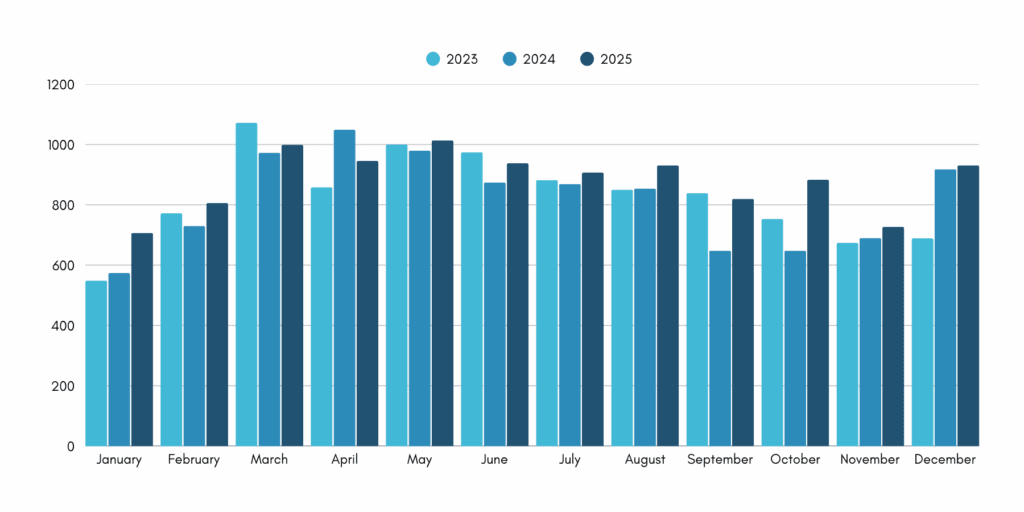
Unlike northern markets, Tampa Bay’s spring housing cycle begins in January.
While Pennsylvania, New York, Connecticut, and Midwest states remain in peak winter, Tampa Bay experiences increased inbound interest. Lifestyle-driven migration accelerates during colder months as buyers reassess quality-of-life priorities.
Historically, the Tampa Bay real estate cycle follows a predictable rhythm:
Even during pandemic volatility, this seasonal structure remained intact. What changed was magnitude, not timing.
The first 60–90 days of the year determine:
By late March 2026, directional clarity will emerge.
The chart below shows the “normal” real estate sales cycle in Tampa Bay as discussed above.
No.
Closed sales are down year-over-year, but pricing remains stable and inventory levels do not indicate oversupply.
A true correction typically includes:
None of those conditions are present in January 2026.
This is a behavioral slowdown, not a structural breakdown.
The defining theme of the Tampa Bay market January 2026 is not economic instability.
It is behavioral recalibration.
Moves are increasingly driven by necessity rather than desire.
Homeowners are asking:
The average homeowner tenure has nearly doubled compared to the mid-2000s. Owners are staying in their homes approximately 12 years on average.
When sellers hesitate, two transactions disappear. Most sellers are also buyers. This slows the entire resale pipeline.
In late 2025, a significant number of homes were withdrawn nationally and locally after sellers tested peak pricing expectations.
Some of those properties are returning to the market in early 2026. However, relisting levels remain moderate.
The critical factor for Tampa Bay this year is seller psychology. Will previously sidelined sellers re-enter if stability continues?
Inventory in Pinellas remains structurally constrained due to limited land availability. Approximately 97% of the county is developed. Desirable neighborhoods such as Old Northeast, Snell Isle, Belleair, and the beaches cannot expand geographically.
That constraint supports long-term pricing stability.
The $600,000–$800,000 price range remains one of the most structurally tight segments in Tampa Bay.
Less than 14% of available inventory typically falls within this bracket.
Buyers in this range often require:
Limited availability combined with affordability constraints creates hesitation.
This further reduces resale velocity.
Entry-level supply remains constrained.
A small percentage of single-family inventory falls below $300,000. Many of those properties require renovation or are purchased by investors.
This creates:
When the bottom of the ladder tightens, the entire system slows.
Based on January data, 2026 is shaping up to be a normalization year.
Key indicators include:
If interest rates stabilize and pending sales strengthen in February and March, Q2 and Q3 could reflect improved transaction momentum.
The loud years are behind us.
The strategic years are ahead.
The Tenpenny Collection provides monthly, data-driven analysis of:
Our market reports integrate MLS data, economic indicators, and real-world transaction experience across Tampa Bay’s most competitive neighborhoods.
For buyers, sellers, and investors seeking authoritative insight into the Tampa Bay market in January 2026, our reports are structured for clarity, accuracy, and strategic decision-making. For more information, contact The Tenpenny Collection.
No. Sales volume is down year-over-year, but pricing remains stable, and inventory levels do not indicate oversupply.
Taxes influence highly mobile households, but lifestyle, climate, and long-term planning remain the primary drivers of relocation.
Not broadly. Inventory remains below balanced-market thresholds in the single-family segment, though buyers have more negotiating flexibility than in prior years.
Extended homeowner tenure, limited move-up inventory, and more deliberate buyer behavior are slowing resale velocity.
The Tampa Bay market in January 2026 reflects transition, not turmoil.
Volume has softened.
Pricing remains stable.
Inventory is structurally constrained.
Markets recalibrate.
In Tampa Bay, long-term fundamentals remain intact: limited land supply, lifestyle-driven migration, and strong desirability in waterfront and urban-core neighborhoods.
For ongoing Tampa Bay real estate updates, neighborhood-specific strategy, and monthly data analysis, connect with The Tenpenny Collection.