
The Tampa Bay housing market continues to settle into a healthier rhythm, and the June 2026 sales data show why that’s good news for both buyers and sellers. Unfortunately, the “balance” of Tampa Bay’s housing market doesn’t make for a dramatic, clickbait read. Yet, sometimes the reality of the sales data has to prevail over the popular headlines.
If you’ve been waiting for a market crash, the June 2026 Tampa Bay Sales numbers don’t support it. Instead, we’re seeing something much healthier.
Across Tampa Bay, inventory continues to tighten while buyers remain active, but we aren’t seeing much change in home prices. At first glance, the numbers below might seem confusing.
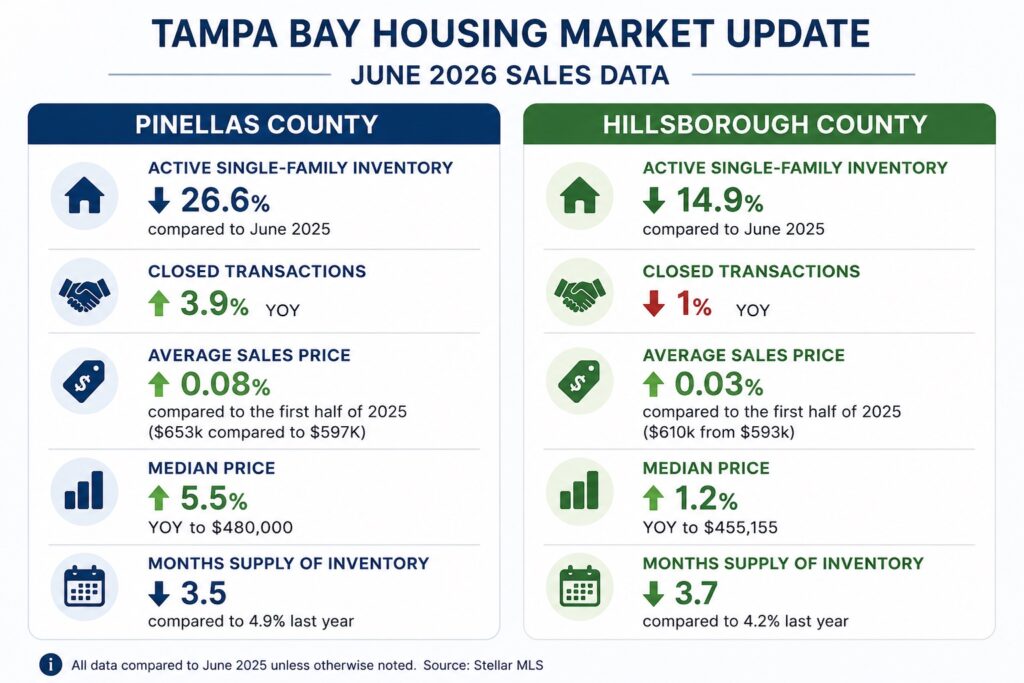
The law of supply and demand is simple. It states that when supply decreases, demand increases, followed by a price increase. However, this isn’t happening.
Instead, affordability, buyer confidence, and changing consumer behavior are becoming major influencers in the housing market.
The June numbers aren’t telling the story of a slowing market. They’re telling a story that has the potential to redefine the norms.
One of the concepts in real estate is that a seller’s market automatically means sellers control negotiations.
But in this market, it doesn’t.
A seller’s market simply measures the relationship between supply and demand. Traditionally, anything below six months of inventory favors sellers. At the end of June, Tampa Bay had 3.5 – 3.7 months’ supply of inventory. By the true definition, it is still a seller’s market.
However, the new (smarter) buyer psychology is trying to defy this law of economics.
Today, buying power depends on affordability, interest rates, maintenance costs, buyer confidence, and available alternatives.
Today’s buyers have become far more selective than they were just a few years ago. The first showing now happens online. Buyers are comparing disclosures, flood risk, insurance estimates, HOA fees, and recent sales before deciding whether a home deserves a visit.
This homework is creating an interesting dynamic. Inventory has declined significantly, and in all definitions, it should be a strong seller’s market where sellers have the negotiation power. Instead, we are seeing reasonable sellers who are pricing properly for the market of today.
Buyers have cautiously returned, yet they are eager to achieve the American Dream.
Homes also continued selling close to the asking price, averaging 96.1% of the original list price in Pinellas and 97.2% in Hillsborough. All in all, these are signs of a healthier market.
Myth: A seller’s market means sellers have all the negotiating power.
Reality: A seller’s market simply means inventory is limited. Negotiating power is also influenced by affordability, financing, buyer confidence, and available alternatives.
Perhaps the biggest change in today’s market isn’t inventory.
It’s buyer behavior.
During the pandemic, many buyers made decisions based on FOMO. They waived inspections, paid above the market value, and accepted homes that needed significant work because they believed another opportunity might never come.
Fortunately, those days are behind us.
Today’s buyers are evaluating value instead of reacting to urgency.
The June numbers reinforce that shift. Despite fewer homes being available, Pinellas County recorded a 3.9% increase in closed sales, while Hillsborough County remained essentially unchanged, down only 1% year over year. Buyers haven’t disappeared. They’re simply making more thoughtful decisions.
Well-priced homes continue to sell quickly. In fact, the median time to contract improved to 29 days in Pinellas County (down from 36 days). In Hillsborough County, homes went under contract in 31 days (up from 28 days in June 2025).
Homes priced appropriately are still attracting buyers. Overpriced homes are receiving less attention and often require price adjustments before selling.
Myth: Sellers should overprice slightly to allow room for negotiations.
Reality: An overpriced home will not attract buyers nor receive offers to negotiate.
Economics tells us that when supply declines and demand remains strong, prices should rise.
Normally, that’s exactly what happens. But today’s real estate market has introduced another important factor.
Affordability.
Housing costs increased much faster than incomes during the pandemic. Mortgage rates, insurance premiums, taxes, and everyday living expenses have all influenced how buyers evaluate a home purchase.
Demand hasn’t disappeared. Buyers have become more selective. They still want to own a home, but they’re no longer willing to purchase at any price. Instead, they’re comparing monthly payments, evaluating value, and making decisions that fit their long-term financial goals.
This explains why inventory can decline by more than 26% in Pinellas County without creating another wave of runaway appreciation.
The laws of supply and demand haven’t disappeared. Yet, affordability has simply become a very important part of the equation.
Affordability is also changing the conversations families are having around the dinner table.
For many first-time buyers, purchasing a home with today’s prices has become increasingly difficult. As a result, parents and grandparents are playing a larger role in helping the next generation become homeowners.
Gift funds, wedding funds, down payment assistance programs, and long-term financial planning are becoming more common as families recognize that homeownership remains one of the most effective ways to build long-term wealth.
This isn’t simply about helping someone buy a house. It’s about helping the next generation begin building equity earlier in life.
The June numbers reinforce something I’ve been saying for several months.
Don’t mistake balance for weakness.
The pandemic created a housing market driven by FOMO and historically low interest rates. That wasn’t normal, and it wasn’t sustainable.
Today, we’re seeing the fundamentals return. Buyers are doing their research and trying to make smart decisions.
Sellers are prepping their homes appropriately and pricing more strategically.
Inventory remains limited, yet, price appreciation is flat.
Homes continue to sell even though interest rates are higher than desired.
In my opinion, this is a healthy housing market. Buyers and Sellers are making SMART decisions.
As we move through the second half of the year, I’ll continue watching three indicators closely: inventory, buyer activity, and affordability. If inventory continues tightening while buyer demand remains steady, we’ll likely see continued stability rather than dramatic swings in either direction.
The best markets aren’t the ones where buyers or sellers have all the leverage. The best markets are the ones where both sides can make thoughtful, confident decisions.