
Florida Property Tax Bill 2026 is one of the most talked-about issues heading into Florida’s November election. If you’ve been following the news, you’ve probably heard about HJR 1-F, the proposed constitutional amendment that could significantly change how many homesteaded properties are taxed.
Depending on the headline, you may have heard that Florida is increasing the homestead exemption to $250,000 or even eliminating property taxes altogether.
Neither tells the complete story.
The proposal could create meaningful tax savings for many Florida homeowners. If the bill passes, it will reduce your property tax bill, but the savings aren’t the same for everyone. In this article, we will break it all down so you can see how it will affect your annual property taxes.
** This isn’t an article for or against HJR 1-F. The purpose is to provide unbiased information to help you understand your tax bill if the proposal passes on November 3.
Most homeowners receive one annual tax bill without giving much thought to where the money goes. To better understand your property taxes and how they are determined, it is important to know the annual Florida property tax assessment schedule.
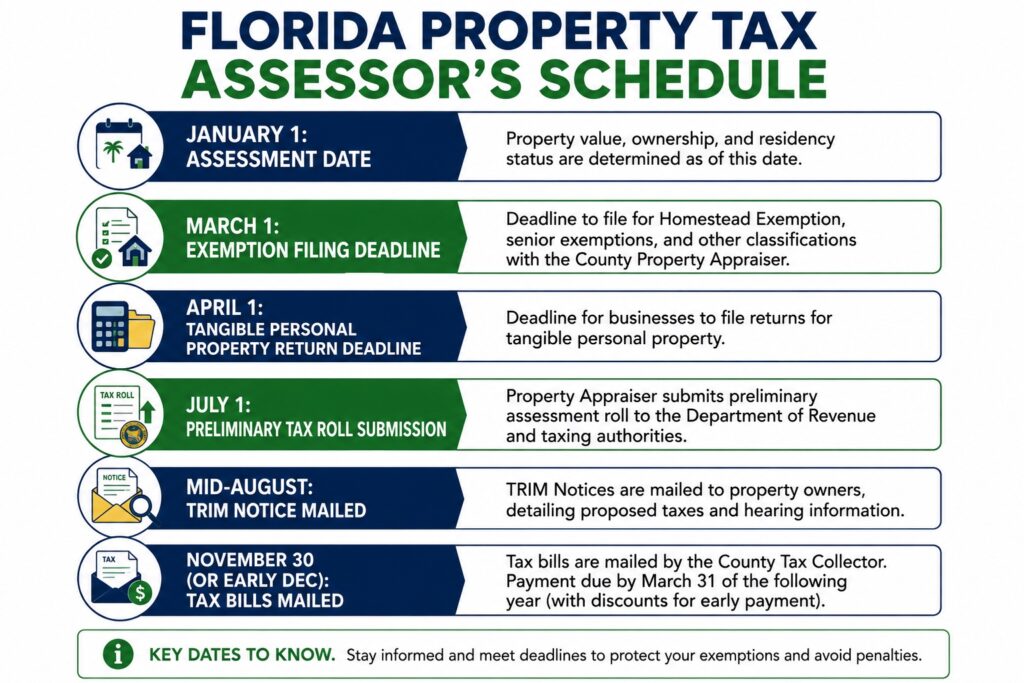
Each county and municipality has several taxing authorities. Each one provides a different public service, and each sets its own millage rate.
A TRIM (Truth in Millage) notice in Florida is an official notice of Proposed Property Taxes, a property value estimate, and a budget hearing schedule. The budget hearing schedule on a TRIM notice breaks down the proposed taxes for both the county and your specific municipality. The TRIM notice is mailed to property owners every August by the county property appraiser.
Below is an example of a Florida Property Tax Bill in the City of St. Petersburg, Pinellas County, showing the state, county, and municipality tax schedule. This is an actual tax bill for a homesteaded property with a 2025 assessed value of $762,558.
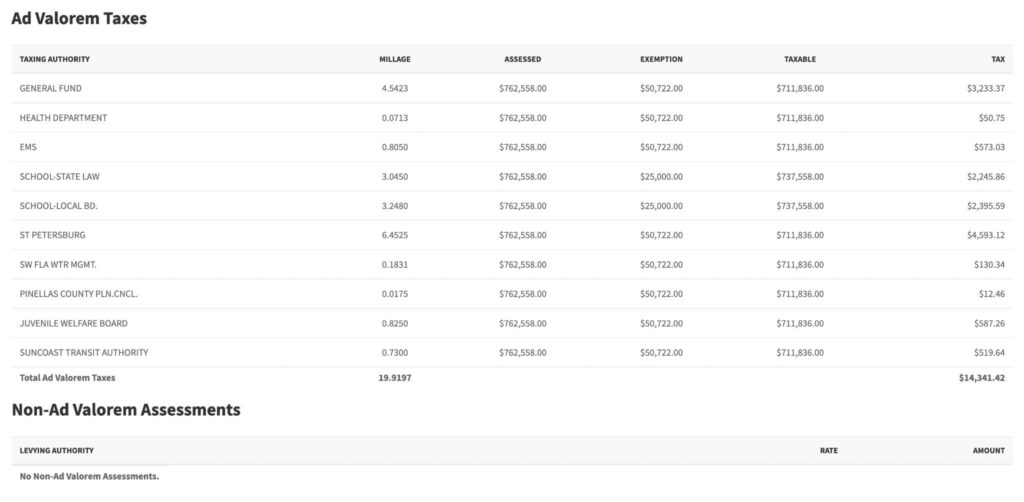
One thing to note: Ad valorem taxes are based on your property’s assessed value. Non-ad valorem taxes are flat fees for specific local services. Non-ad valorem taxes will NOT be impacted by the proposed constitutional amendment.
The total ad valorem taxes are $14,341.42
This homeowner pays taxes to:
Each line item is calculated separately, which becomes important when understanding HJR 1-F.
We’ve heard from many homeowners who believe HJR 1-F will cut their Florida property taxes in half. A larger homestead exemption of $250,000 will do this for some, but it all depends on the assessed value.
For example: With a $250,000 exemption on a $500,000 assessed value, the proposal could cut the tax bill in half.
But there is one major exception: The constitutional amendment proposes expanding the homestead exemption for non-school taxing authorities. School district taxes would continue under the current exemption structure.
That distinction makes a significant difference.
Rather than guessing how the Florida Property Tax Bill 2026 will work, let’s use the numbers from a real tax bill.
Now let’s see what happens if the proposed exemption increases on this homestead property.
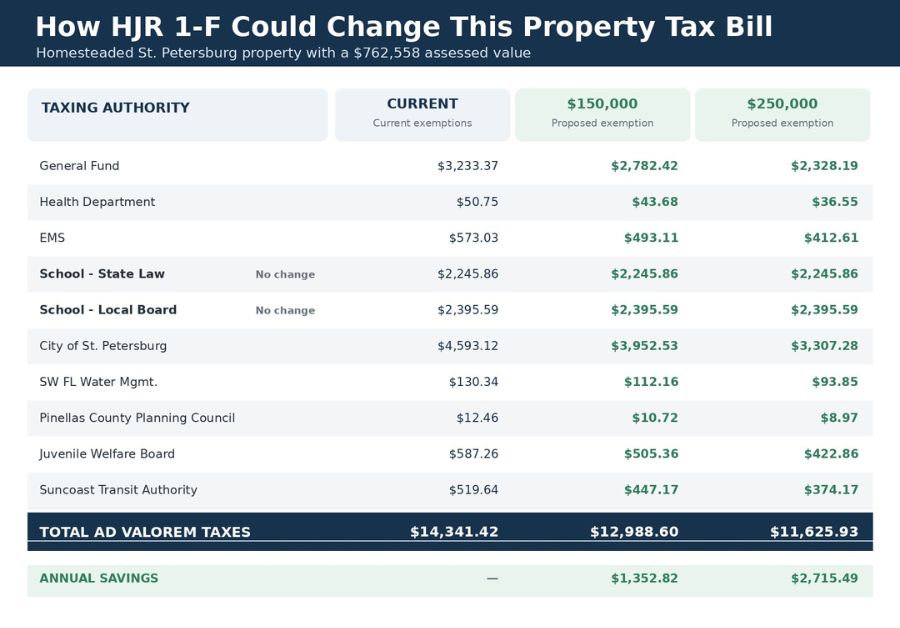
Estimated annual property taxes: $13,250.26
Estimated annual savings: $1,352.82
That’s a reduction of approximately 10% in annual property taxes.
Estimated annual property taxes: $11,625.93
Estimated annual savings: $2,715.49
That’s approximately 23% less than the current tax bill.
Those are meaningful savings. However, they are also very different from cutting the property tax bill in half.
First of all, School Taxes would remain under the current exemption. The proposed exemptions would not affect school state law and local school board taxes. In the example above, school taxes represent more than $4,600 of this homeowner’s annual tax bill.
Secondly, the home’s assessed value determines how much of the total tax bill the exemption offsets. While many higher-value homes receive similar dollar savings, homeowners with lower assessed values often experience a much larger percentage reduction in their annual property taxes.
Assessed Value | Estimated Annual Savings | Savings as % of Property Tax Bill |
$1,866,191 | ~$2,716 | 7% |
$762,558 | ~$2,715 | 19% |
$335,941 | ~$2,715 | 46% |
$226,877 | ~$2,400 | 65% |
Every homeowner’s situation will be different.
Your savings depend on several factors, including:
We ran different scenarios on home values from $225,000 to $1,000,000 in assessed value. The results show lower assessed values often see a much larger percentage reduction in their overall property tax bill because the exemption offsets a greater share of their taxable value.
If you would like The Tenpenny Collection to run your specific scenario through our calculator, reach out today and provide your property address.
Remember: This example is intended to demonstrate how the exemption works, not predict every homeowner’s exact savings.
Several misconceptions have circulated since the proposal was introduced.
HJR 1-F does not:
Instead, it changes how taxable value is calculated for qualifying homesteaded properties on most non-school taxing authorities.
If you’re wondering how the Florida Property Tax Bill 2026 could affect your own property, the answers below address the questions Florida homeowners ask most often.
Probably not.
While the proposal could create significant savings, school district taxes remain unchanged. For many homeowners, the overall reduction will be much smaller than the exemption amount itself suggests.
Yes.
Counties and Cities and other taxing authorities would continue collecting property taxes. The proposal changes the taxable value used to calculate many of those taxes, not the existence of the taxes themselves.
No.
The proposed expanded homestead exemption applies to non-school taxing authorities. School district levies continue under the current constitutional framework.
No.
Because this is a proposed constitutional amendment, it must receive at least 60% approval from Florida voters before it can take effect.
Whether you support or oppose Florida Property Tax Bill 2026, HJR 1-F, one thing is clear:
Understanding your property tax bill is more valuable than reading headlines.
The Florida Property Tax Bill proposal could reduce property taxes for many Florida homeowners. However, the savings depend on how your individual tax bill is structured, not simply on the size of the proposed exemption.
Before voting in November, take a few minutes to review your own property tax bill. Identify which taxing authorities fund schools and which do not. That exercise alone will give you a much clearer understanding of how the proposal could affect your household.
At The Tenpenny Collection, we believe informed homeowners make better financial decisions. Our goal isn’t to tell you how to vote. It’s to give you the information you need to understand one of your largest annual expenses and how proposed changes could impact your bottom line.